

From First-time Author to 10,000 Books Sold: Sherry McMillan on Creativity, Publishing, and Building an Author Career
/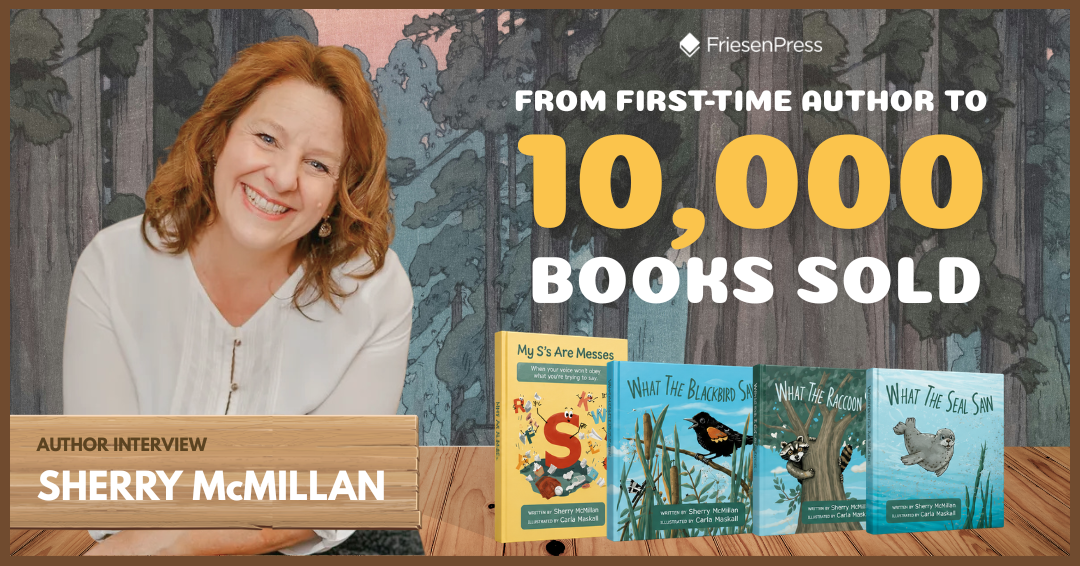
Award-winning children’s author Sherry McMillan didn’t set out to build a publishing business or sell thousands of books around the world. What began as a desire to live a more creative life quickly evolved into an acclaimed children’s book series, a thriving coaching business, and a full-time writing career.
Guided by her mission to “nurture a love of nature and language in little ones with big imaginations,” Sherry published four books with FriesenPress in just five years, including three titles in her acclaimed Naturally Curious series and My S’s Are Messes, inspired by her lived experience with speech sound disorders.
In our conversation with Sherry, she reflects on her journey from business analyst to author, selling more than 10,000 books, what she’s learned about sales and marketing along the way, her proudest moment as a children’s author, and so much more.
Our conversation has been edited for length and clarity.
Let’s talk about your own personal evolution over the past few years. You have a background in the corporate world – how did you find your path to writing and publishing?
The journey in the past four or five years has been so interesting. If I step back a little bit about three years before that, I realized that I had a burning desire to lead a more creative life – whatever that looked like.
I worked with a life coach, and the two things that we were looking at the most were writing and music. I had been a music major, and then I fell into tech, and I was so grateful. I had this robust, very fulfilling career in technology – and in fairness, quite a bit of that was writing. I specialized in business analysis, where you would listen to what the needs of the customer were, do some assessments and analysis on the true opportunity to realize, and then create documents for different types of audiences. I was always writing [at work], and there was a creative element, but I really wanted to lead a more creative life, and was trying to think about how to do that.

Over COVID, I picked up the sport of kayaking, and while I was mulling over all these ideas, I had a very literal experience where a seal popped up in front of me. I spontaneously spoke to it in rhyming verse, because sometimes when you're out on the ocean alone, goofy things like that will happen, and I thought, "Oh, that's interesting, that's that universal experience of seeing an animal in nature and wondering if it sees you too”. I challenged myself: “could I write about that?”
I instantly went back to being a child and loving children's poetry. I thought, I'm going to see if I can write the kind of book that I loved reading as a child. At the same time, because it was COVID and I have a lot of nieces and nephews, I was doing these Zoom calls with children – story time with Auntie Sherry. That sort of dovetailed, and I ended up writing What the Seal Saw based on those experiences. From there it really took off.
How did that pursuit turn into a series? When did you realize that it could potentially be something more?
I noticed that a good third of my sales were coming from people who wanted to see real natural locations depicted in books. Those who either lived locally and wanted to see their own community expressed in the book or tourists who wanted to capture the wonderful place they visited. The books are shared all over the world so they can say: “this is what it's like where Nana lives,” or “this is what it's like where your uncle went to university.”
I thought about how much I loved seeing New York with the Stuart Little series, or loved seeing Paris with Madeline. I live in this beautiful place – let's really dive into that. Very quickly, it turned into different ecologies – because what's so beautiful about the Pacific Northwest is that we have the ocean, the forest, and the wetlands right here, and that is such a special part of our ecology. I leaned into the animals I love, so when it came to doing the forest, it had to be the raccoon. I didn't have teddy bears when I was growing up – I had raccoons. And I love the red-wing blackbirds.
I wanted to ask about your relationship with your illustrator, Carla Maskall. How did you connect with Carla, and what's your collaborative process when working with her?
Thank you for mentioning Carla so we can highlight her amazing contributions!
Carla and I actually grew up together. We met in middle school. When I knew I was going to be published, I thought about illustration and had known she was an award-winning artist, and so I reached out to her and asked if she'd like to work with me on this. We were very open about how to work together as friends and then as partners in a business endeavour, so it was fantastic that we had that trust together.
We are very similar in the mindset that we're both very ambitious. We both really care about quality, getting it right, and doing the thing that we believe in – whether or not it's popular or that we think it's going to have a return on investment. We wanted, first and foremost, to create books that our readers would love and that would stand the test of time, and then think about the buyers and what they would be looking for. We had that in common, but we also really had a similar ambition to make some goals and get out there to make this thing work. We were really blessed that we aligned so well on that – and that's a good match, right?

FriesenPress's book coaching service brings a structured, expert-driven approach to the creative process, helping you leap over writing obstacles while making progress on your book. No matter where you are in your writing, we empower you to confidently transform your output into a high-quality, publishable manuscript.
From when you spoke with the life coach and thought “I want to be more creative, I have this spark in me that I want to nurture,” how long did it take you from hitting that moment to actually starting to write and then publish?
One of the great ironies of the universe is that it was a fun project that was basically just for me. My thinking was, “I’m going to challenge myself to write what I see.” It was very zen.
That book came together over a summer of kayaking, working with Carla on the illustrations, and deciding that I wanted to work with a publishing company that was fee-for-services. I would leverage [FriesenPress’s] expertise and let you guys handle the admin – the things that I’m sure I could do on my own if I wanted to, but I had a full-time job and I wanted to lead a more creative life, not add more admin to it.
From the time I started coaching to the time I wrote Seal was about four years. From the time I wrote Seal until it was published was only one year, and that was about five years ago. That’s five years, four titles, three major awards and honours, and 10,000 books sold.
On that journey to 10,000 (and counting), was there a specific moment where you realized things were picking up steam sales-wise?
There’s been no big moment or epiphany in how the sales go. But what I have noticed (and what has been validated over time) is that there are different channels for sales.
You’re always going to have spikes. You’ll have one book-signing event at a chain that just goes gangbusters and another one where you hope you made some good connections, but if you counted your profit per hour, it would make you sad. [Laughs] There are avenues where you knock on doors and they don’t answer, or they’re delayed – all the things.
What I learned is there are basically three different ways to sell books. You have online, which was my vision. I envisioned that I would be an author who had books available on Amazon or other online avenues and that I would maybe run ads and send people there. I never envisioned having books in my basement or doing live events. Then there’s retail, and within retail you have your big players, your small players, author-direct wholesale, consignment, and all those different options. Then there’s author-direct sales where you’re really getting in front of people. I’ll go into farmers markets and craft fairs and church basements and curling clubs and all the things.
One of the really interesting things I realized over time is that [the three ways] all feed each other. Something that I learn at a live event will help me fine-tune a pitch that I can give to a retailer in a sell sheet, or help me understand what a teacher might be looking for if she’s going to bring me into the classroom. No matter where you are, you want to be listening and watching and engaging, because you never know what seeds you’re going to plant that are going to pop up elsewhere.
Has settling into life as an “author” aligned with your expectations around what that might have looked like for you prior to publishing? I imagine that might inform your coaching process, too.
I think a lot of authors feel pressure to realize a romanticized version of what being an author is like. We’ve all had that daydream of a big-five publisher giving us an advance. But it’s an unrealistic expectation. And even for people who do have that happen, I think we imagine that they’ll do all the marketing and we can just sit at our desks uninterrupted in a writing paradise. It’s not like that.
There are really three parts of the journey: writing, publishing, and sales and marketing. You can be a writer and never publish. You can be a writer who publishes but doesn’t need huge sales. Or you can say, “I’d love to do that, but right now life circumstances don’t allow it.”
One of the amazing things about being self-published is you don’t have to have that pressure. Everybody thinks your launch day is your best sales day, but Robert Munsch has shared that the highest sales year he ever had for one of his books came years after publication. Success doesn’t have to happen on one particular timeline. It can be what you consider success.
You can also participate in any point of the process to the extent that makes sense for you. I happened to get hit by the entrepreneurial bug. I didn’t see that coming. The most important thing for me was simply to publish something that I could really be proud of. Then I got going. But that might not be for everybody. I want to assure writers and authors that you can own that decision, and you can also remake that decision.
One thing I appreciate about FriesenPress is that I own the copyright, but the company provides the publishing services so I don’t have to source them myself. Editing, proofing, page design, distribution channels, all of that. That also takes pressure off the writer. And because the timeline is in my control, there’s nobody at the publishing company saying your best month has to be launch month. You can publish and then decide to take a couple months to relax before doing a big launch.

What are you most proud of so far on your author journey?
I feel very proud today. I’m proud that I did it. I’m proud that the books are out there. I’m proud that I didn’t rush. I didn’t write something just to ‘be published’. I wrote what I believed in and the kind of books I wanted to read.
To be honest, the awards have also been validating. When you wait until you’re 50 to write a book and six months after publication it gets [a Heather’s Pick at Indigo Canada] – one of the biggest honors from the biggest retailer in your nation – I’m still processing that. Then the second book also got awards, so that’s been really validating too.
Of course, the most meaningful moments are when you see the books in children’s hands.
Every Christmas there’s at least one afternoon where I need to disappear and process because people start sending me photos of their children opening the books or seeing them under the tree. I’ve had children run into my tent at markets and grab the next book in the series while their parents run behind them trying to catch up. Then the parents say, “Of course you can have a new book.” Nothing compares to the moment when someone picks up your book and reads it back to you, especially a child.
I’m also really proud of what Carla and I built together. We supported each other creatively, helped each other grow, and worked through fears and challenges together, public speaking, approaching art councils, all those things.
And I’m proud that I’m now able to help other authors. Seeing their work succeed is an amazing thing too.
Last question: what’s next for you, Sherry? Any upcoming books or projects that people should know about?
I do have a few things in the works, but I made the decision that I wanted to get my coaching fully set up first.
Because the last five years have been such a whirlwind, I also gave myself permission to do what I call “cleaning up the kitchen after cooking up a storm.” I’m doing practical things right now: updating my website, organizing inventory, invoicing, all those pragmatic business tasks. Once I’ve worked through that, I’m going to carve out more dedicated headspace for writing again.
The next book will likely be a middle-grade adventure – although it may become YA as I write it. I’d describe it as Doctor Who meets Voyage of the Dawn Treader meets Swiss Family Robinson.
We’ll definitely be on the lookout for that! Thank you for speaking with me, Sherry.
Thank you so much.
Interview conducted by Brian Cliffen, FriesenPress Employee Owner and Marketing Manager.
Learn more about Sherry at sherrymcmillan.ca and on social media @sherrymcmillanwrites.


