

Ask the Experts: Your Publishing Questions, Answered [ Webinar Transcript ]
/
The following content comes from a free FriesenPress training session broadcast live on October 14, 2026 (edited for length and clarity). Register here to join us live on our next broadcast!
Hello and welcome to the Ask the Experts webinar. My name is Brian Cliffen. I'm the Marketing Manager and an employee-owner here at FriesenPress.
If you've joined one of these webinars before, you might recognize me as the moderator of the Q&A session that takes place at the end of each of our webinars. Today, we’re doing something a little bit different. A full-length Q&A based on questions submitted by writers and authors like you.
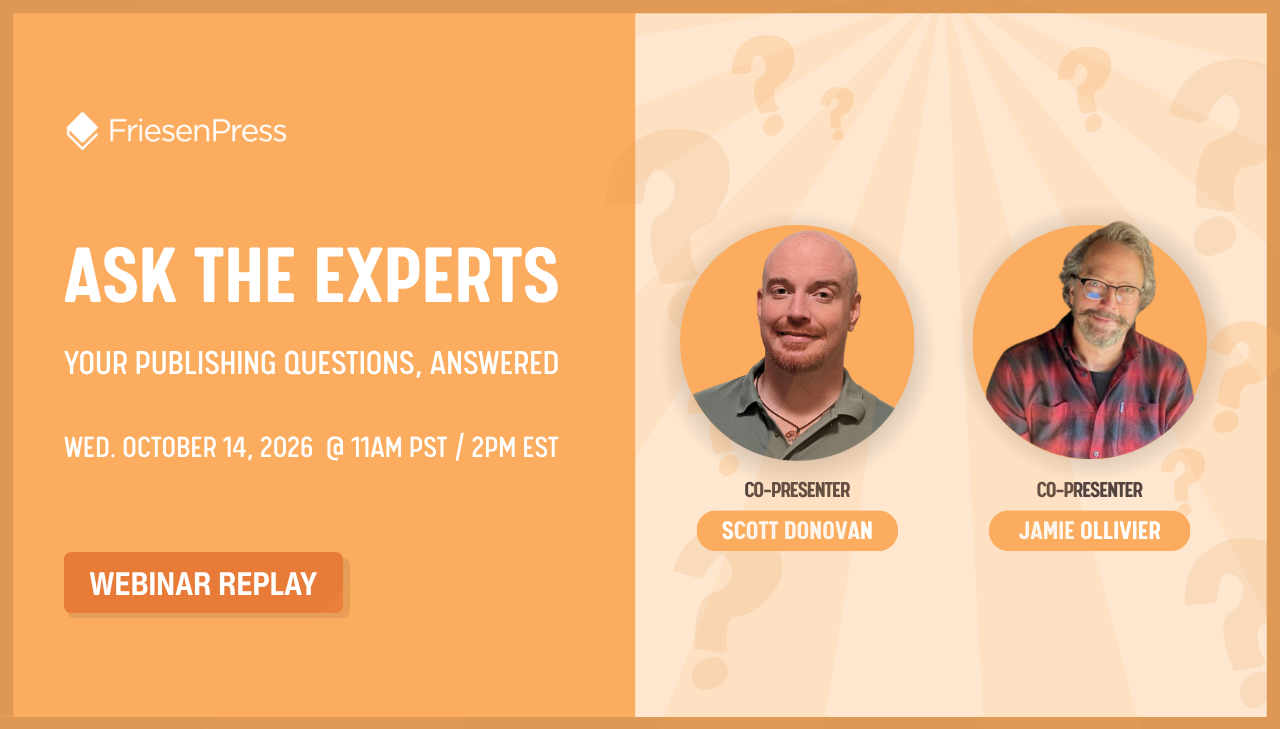
Since the webinar is called Ask the Experts, why don’t we start by introducing our two expert co-presenters:
Jamie: Hello, my name is Jamie Ollivier. I've been here at FriesenPress for over twelve years and I am an employee-owner. It's really been a fantastic role here working with authors all over the world, helping them bring their stories to life.
Scott: My name is Scott Donovan. I come from a modest background in newspapers and I've been at FriesenPress for eight years now as an employee-owner. I really appreciate the collectivism that we enjoy here. And working with authors really has been just a huge privilege and benefit in my life.

How long does the FriesenPress publishing process take on average?
Scott: How long does the FriesenPress publishing process take on average? Scott, maybe I'll give this one to you. We quote authors between five and twelve months. That's quite a wide range. The reason for that is, you know, there are four main pillars to what we do and what can take up time is collaboration and editing.
We don't want to rush you through any decisions and working through your manuscript. But if you think about that back and forth over the course of 50 or 60,000 words, doing a good job on it does take time. The other part that can really take some time is showing you how to run your book business and set up a platform for promotion again. There's training involved. It's a learning curve.
I always tell authors that you won't be waiting on us. It's actually the other way around. We're going to be taking you through a process and there's going to be steps where you're going to find you're taking maybe more time than you expected.
And when you compare it to the two-plus years of traditional publishing where you actually might not hear from anyone, it's a pretty good deal.
Jamie: One of the big opportunities is for authors to be asked challenging questions about their audience, their objectives for the book. Oftentimes authors don't really think about this stuff.
Part of what we do is elicit from you things that are really important that you don't necessarily think about and that can actually add time to the overall development. Once we do the initial review, the editor may have notes for you. And sometimes authors take time. They take a few months to make revisions and then they come back.
It really is sort of a case-by-case basis, but typically it's five months with no editing and up to twelve months if we do something like a children's book that's full of illustrations.
When should you consider finding an agent versus self-publishing for nonfiction books?
Scott: I would first challenge the idea that traditional publishing is superior to what we do. You know, publishing a book is like starting a small business. And traditional publishing is like having a silent partner that gets to make all the money while you do all the work. I think the biggest myth there is that traditional publishers are going to promote your book and do that work for you, when in reality the advance is usually $500. You typically have to trade ownership of the manuscript to them. Then you have to promote the book to pay them back what they've invested in the project. That's sad if you are comparing traditional vs self-publishing and seeing if it's worth pursuing traditional.
The first question you have to ask yourself is, how many followers do I have on social media? Because literary agents are typically looking for a minimum of 10,000 followers and even that's slow these days. Remember that you're not, you're not pitching a literary agent, just your manuscript. You are pitching them a business proposition, and they're going to take that to a traditional publisher who's looking to make the most amount of money for the least amount of work. If you don't have a big social media following, it's time to start building one or consider whether your goals align with those of a traditional publisher.
I will add, we have quite a few authors who after having built a resume and publishing with us and built an audience and been through this experience, you know, they have gone on to what, what could then become lucrative traditional publishing deals because now they have some cards when they're sitting at the table.
So, again just to recap that traditional publishing is not necessarily superior to professional self-publishing like we do at FriesenPress. In terms of whether it's worth pursuing, the real question is what do you have to offer them from a business proposition and it has to be more than your manuscript.
Jamie: I have kind of a unique perspective because my wife has traditionally published, she's with the big US company's been around for over 100 years, and I hear directly from authors really interesting stories.
One author in the UK, she signed with the traditional publisher. She had 20,000 followers. That's the minimum that I heard. The author signed with the traditional and then halfway through the production process, the publisher audited the author's social media network. The author had not grown it at all in that time and they cancel the project. Just that simple.

Social media is a really big deal. They expect you to have a great book number one and an audience number two. I think since the pandemic hit, all of the publishers became very risk averse. They're actually pushing all the risk onto the authors because they don't want to take a chance.
And I just want to add to that briefly: just remember there are lots of bad books that go on to sell thousands of copies and lots of good books that don't sell any copies at all. So, it's not necessarily your manuscript.
Brian: I think in terms of calling your question to one thing I wanted to dwell on a little bit too as a factor that determines whether it's worth it to find agent or traditional publisher is timeline as well.
That's a huge one. You could spend years querying agents, getting rejected, and hopefully eventually getting accepted. But we find a lot of people kind of go through that cycle for a while and kind of kind of pretty discouraged on the end of it.
So, that's a factor to how fast you want to get published, you know, investing in yourself up front. That can really, you know, move that journey along. By the time you found a traditional publisher, you might be on your second or third book already be a self-publishing.
Scott: If I can add something regarding my wife’s experience, it's always a great example. When you sign with traditional publisher, you might not think about something like the foreign rights to your book, but a company can approach your publisher and say we want the Russian rights, we want the Spanish rights, we want the Portuguese rights. And what happens is, in my wife’s case, they did a deal to make her book was available in all these different languages, but she didn't make a penny on that. They even did an audiobook and had a woman with the most annoying accent you've ever heard doing the narration, but again, my wife had no control over that.
Basically when you do sign with their traditional publisher, it's just that you just don't know what's going to happen. You lose complete control, even over derivative things like audiobooks and other opportunities to have your book out there. It can be really surprising that they don't do that. And if you self-published, then you have complete control over all of those different facets.
To what extent should generative AI be used for books?
Jamie: Generative AI, which is when you ask it to do something like “write me a book on macramé” and it just does it. That’s something we have no interest in and you don't either because you can't copyright that book. If you use generative AI in your book and then try to enter a contest, it'll get rejected. They can tell if you use AI in your book. The bottom line is stay away from generative AI.
Now, AI can be okay if you want to brainstorm, but not for producing a final product. That a good use of it in the writing process that can work well. Basically AI as a generative thing is a potentially seriously problem for authors. If you have anything in your manuscript or your book once it's published that someone can search and then identify that it's AI, then you can get disqualified from all kinds of opportunities. For instance, influencers won't even look at your book if you have an AI cover.
Anything that uses AI as an assistant, fantastic, but double-check its work, because you want your manuscript to use your own words and not with AI. That's the only way to get past all of those pitfalls and avoid those doors closing.
Scott: As a university student, I see academic policy struggling with this. As a book lover, I can tell you, it is noticeable, it's very identifiable and using generative AI will wash your voice out of your manuscript.
There is an art form here and the industry is becoming very protective. I don't think we're going to see that go away anytime soon. There's a good chance that we're going to see distributors and retailers push back against anything that even has a whiff of AI on it.
At the end of the day, if someone's purchasing your art, make sure it's yours.

Professional editing reduces distractions that diminish your book's readability, such as convoluted content structure, incorrect grammar, and persistent typos. From developmental editing to proofreading, our vetted editing team will match you with the editorial services you need to create the best book possible.
What is developmental editing, and how does it work?
Scott: Authors often contact us and say, 'I don't want to change my voice', I don't want to go in there and make this book on manuscript different. And we don't. What we do is we do two types of editing, copy editing, spelling, punctuation, grammar, syntax, all the mechanical stuff with the English language.
The other type of an editing is developmental editing. That's when the editor would write notes for you in the margins of the manuscript, and those notes will have a line that will go to specific sentence or words and that sort of thing. So, you would read the note and then you would make the changes.
I've got a good example at an author running a western with two guns slingers and it describing the High Noon showdown and the sweat dripping down the brow and the guns and everything. And the developmental note was great gun, a great scene, but the guns you're describing in the scene don't exist. But here's some that do. In that scenario, the author actually cuts and pastes the name of the gun into the manuscript. Now it's correct.
Basically the editor guides you with developmental notes and then the author actually makes the changes themselves.
What are the advantages of two rounds of copy editing, and when are two rounds necessary or preferable?
Jamie: Usually what happens is there's a substantive edit. You do the big edits first and that's the edit of the author going there making those changes and then you'll have a manuscript that's maybe 80% error free and then the editor will go in there, fix spelling, punctuation, grammar and syntax, that sort of support.
We can get it up to maybe 89% error free and then a proof read with the brand new editor never seen it before we can get it around 95% error free. That would be considered sort of industry standard. Every manuscript in the perfect world has two rounds of copy editing from two different or even three or even three.
In the traditional space, they do the same thing, putting books through multiple rounds with each round of editing catching something different. The more rounds you do, the fewer errors you theoretically end up with.
Scott: In my wife's experience, on her second book, someone at the traditional publisher made a mistake and they published the version that was not the final final version. So, no one's perfect, even traditional publishers.
Brian: I think it might surprise some people to hear that editing is not a 100%, but these are human beings doing real human work and bringing human thoughtfulness to that work. Things can happen in traditional publishing, but that's kind of the beauty of all this work we're doing together, we're telling human stories and we're not perfect. I think it's a good note to dwell a little bit there.
Does FriesenPress provide artwork, what illustration resources are available, and how closely can authors work with illustrators?
Jamie: Yes, we have an amazing roster of professional illustrators. We've got some really excellent talent and some even coming from Disney and Pixar. Our illustrations come in three different styles: Personal Touch, Intricate Design, and Fine Art. Personal touch includes simpler two-dimensional characters, larger eyes, simpler lines, that sort of thing. Then we also have Intricate Design and that's more volumetric and three-dimensional. And Fine Art is something like an acrylic painting, which is absolutely beautiful. So, we can do full colour, we can do black and white, we can do line art, all that sort of stuff.
The our authors choose from our roster. We even have a mechanism where you can do some audition sketches. If you've found a couple of illustrators you like but can't decide between them, then we can arrange some audition sketches for you, and you can choose your favorite one.
The life cycle of production with illustrations, it does extend to about 11 months, even 12 months from start to finish. But you'd be be shepherded through that whole process. Also, we start with pencil drawings, you sign off on that, and then they ink them with black lines, you sign off on that, and then we add colour to them. There's an iterative process that the author signs off throughout the entire.
Do self-published books ever get picked up by traditional publishers for a second edition?
Jamie: I've had a bunch of my authors over the years get picked up by traditional publishers. One of my authors, Leah Denbok, an amazing photographer., her dad contacted us when she was 14 or 15 and she was taking photos of homeless people in Winnipeg. We did a bunch of photo books with her and then she got picked up by traditional publisher. She's been interviewed on BBC and all over. It's pretty cool.

We even recently had one of our authors who contacted us as a total amateur. She had a series of completed manuscripts and wanted publish them all. And now, for her future books, she's actually been picked up by one of the big five traditional publishers. There are some really interesting stories of people coming to us using us a stepping stone to get a deal with a traditional publisher that they could not get any other way because we helped prove the book was marketable and has an audience.
I would also point out that the opposite is true. We've had traditionally published authors bring their careers to us because they are no longer being supported by the traditional publisher, but they've already done the work of creating their audience and people are buying their books. Why wouldn't they want to own the work and keep the money? In particular, author Chris Humphreys, who did several blog post with us talking about why he chose to go independent after years as a traditional best-selling author.
I encourage authors to challenge that bias that traditional is automatically better than professional self-publishing with FriesenPress. It's kind of dealers choice, whatever feels right for the author. There's not just one right way.
Also, with non-fiction titles, we have the flexibility to update content that you can't really do it to a traditional publisher. If you've got non-fiction content and then it can go stale in a year or two, no problem. We can actually do a post-publication revision, update the content and republish it, which is just not possible to do through a traditional.
Once an author is ready to begin publishing, what do they need to do to get started?
Scott: If you're ready to start moving that manuscript forward, it's a call. Chatting with us will identify what services are the best fit for your manuscript and your book business.
And then we will put together a custom quote for your recommended services, make a payment arrangement, and then you upload the manuscript to us and we're off to the races.
Jamie: A lot of authors who are new think, Is this worth pursuing? Should I explore this? Is it good? I always recommend actually coming to us and starting with an editor's manuscript evaluation. Let's do that to start.
And that way you'll be able to audition FriesenPress to make sure we're a good fit.It's like a first date. The chemistry, it will be apparent right away, based on what we give you, how the editor marks up the manuscript and provides all the support. I think that's a really great way to start.
So, actually talk to people, try to see if someone can actually look at your material to give you feedback.
Want more expert insights to help navigate your publishing journey?
Join our next free webinar! Presented by FriesenPress’s Emily Perkins, Bookselling 101: How to Distribute and Retail Your Book walks you through the foundational pillars of book retailing, helping you understand how the puzzle pieces fit together while you earn valuable bookstore shelf space.


