

Reach the Summit: Your Guide to Self-Publishing in 2026
/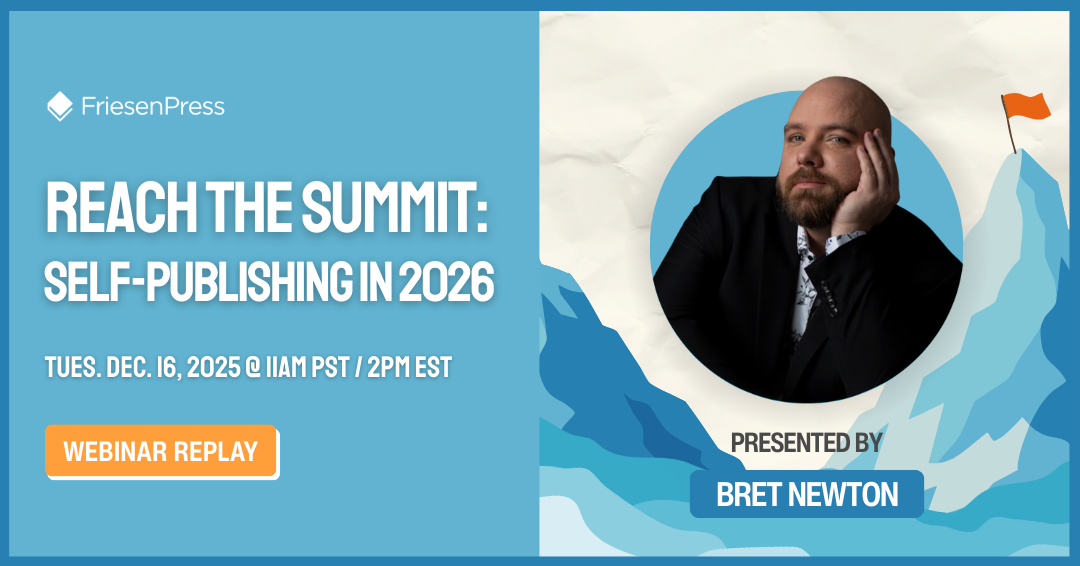
The following content comes from a free FriesenPress training session broadcast live on December 16, 2025 (edited for length and clarity). Register here to join us live on our next broadcast!
Hello everyone, and welcome to our virtual publishing webinar, Reach the Summit: Your Guide to Self-Publishing in 2026. My name is Bret Newton, and I’m your presenter today. I’ve been with FriesenPress for about 11 years now, working as a Publishing Consultant. If you’ve ever called in or requested our publishing guide, there’s a good chance you’ve spoken with me or one of my colleagues.
I’d also like to introduce our moderator, Brian, who will be helping manage the Q&A at the end of the session. As we go through today’s presentation, please feel free to drop your questions into the chat window. We’ll get to as many as we can live, and any questions we don’t answer during the session will be followed up on afterward.
Getting to Finished: When to Stop Writing
If you’re here today, there’s a good chance you’ve started writing or at least started thinking about writing a book. First and foremost, congratulations. Taking that step and showing up to learn how to turn your story into a published work is a big deal.
One challenge many writers face is knowing when to stop revising. Revision is an important part of the writing process, but it can also become endless if you don’t know when to move forward.
After speaking with hundreds of writers every week, I’ve noticed a few common signals that it might be time to consider publishing:
Your manuscript is complete.
This may sound obvious, but many writers leave notes for “future me” to fix later. Make sure all sections are filled out and the manuscript is truly finished.
You’ve done at least one full read-through.
Let the manuscript sit, then read it from beginning to end. This helps ensure your theme, tone, writing style, and structure are consistent throughout. Ideas often shift during the writing process, and reading the full manuscript helps catch those changes.
You’ve done some basic cleanup.
Running your manuscript through spellcheck, Grammarly, or text-to-speech software can help catch early spelling and grammatical issues.
You’ve sought a fresh perspective.
Sharing your work with a friend, beta reader, or acquaintance can be intimidating, but outside feedback is incredibly valuable. The next step after that is professional editing.

Bonus Tip: If You’re Stuck, There’s Help
Every writing process is different, and every manuscript has unique needs. If you’re just starting out, outlining, or struggling to move forward, professional book coaching can help motivate you and get past obstacles.
A book coach can also provide feedback on half-finished or messy first drafts. This support can take place over weeks or months, depending on where your project is at.
For those interested, my colleague Scott will be hosting a writing-focused training session in January. Book coaching is also a service FriesenPress offers, and we’d be happy to talk more about it if you have questions either in the chat or after the webinar.
Why Self-Publish?
When it’s time to move forward, there are a few publishing paths available: traditional publishing, DIY publishing, and self-publishing with services.
Here are the benefits of self-publishing compared to your other options:
First: speed.
Traditional publishing timelines can take years. Self-publishing allows you to move from manuscript to publication much more quickly, which also makes it easier to participate in trending topics or genres.
Second: professional support.
Self-publishing no longer means putting out a poorly edited or poorly printed book. Print-on-demand technology and access to professional editors, designers, illustrators, and marketers have changed the landscape. You can work directly with professionals or with a partner like FriesenPress that offers a vetted team while still maintaining creative control.
Third: creative control.
With self-publishing, you retain 100% creative control. While publishing service providers may offer advice and recommendations, the final decisions rest with you. You’re free to follow your vision without being constrained by agents or publishers.
Fourth: retention of rights.
In traditional publishing, authors often sign away rights to their work. With self-publishing, you retain ownership, making it easier to explore opportunities like audiobooks, foreign translations, or film adaptations on your own terms. Your book also never has to go out of print, you decide how long it stays available.
Preparing Your Manuscript for Publication

Regardless of the publishing path you choose, there are a few practical steps that make the process smoother and more professional.
Export your manuscript as a DOCX file.
This is the industry standard. Most word processors, including Pages and Google Docs, will allow you to export as DOCX.Start with a fresh document prior to submission.
As you're going through the writing process, documents can develop quirks, especially if you're doing revisions and rewrites. Copying and pasting your manuscript into a fresh document can really help to avoid some of the potential pitfalls.Keep formatting simple.
Use easy-to-read fonts like Times New Roman, Arial, Helvetica, or Calibri in 11- or 12-point size. Use 1.5 or double spacing and one space after periods.Use page breaks.
Starting a new chapter or a new section, avoid just hitting enter a bunch of times or the space bar to get to the page instead, insert a page break. This can be done by selecting the insert tab on Microsoft Word. Naturally, during the editing phase, elements will move and shift around, but if you have page breaks versus hitting enter or spaces, things will stay a lot more consistent and the different sections will stay distinct from one another.Set your language.
Are you writing in American, British or Canadian English? Set the language on your word processing programme if you haven't done so already. It's not perfect, but this tool does a great job of catching most of the spelling differences between English variants.
These small steps add up to a cleaner manuscript and make things easier for editors and designers later on.
Core Publishing Services to Plan For
Every author’s goals are different, but there are a few services we almost always recommend:
Professional Editing
At least one round of professional editing is strongly recommended. A content edit, combining developmental and copy editing, addresses structure, flow, clarity, and technical issues in a single pass.
Book Design
Professional cover design and interior layout are well worth the investment. Designers ensure margins, layout, and visual elements work properly and help translate your ideas into a clear, effective cover.
Marketing Support
A strategic marketing plan and a strong author website form the foundation of book promotion. Additional tactics—such as social media or in-person events—depend on your target audience.
Print and Distribution
Print-on-demand allows readers to purchase books through retailers while giving authors flexibility to order small or large quantities. It also supports direct sales at events, which can be a significant profit driver.
Audiobooks
Audiobook sales continue to grow, and many readers now consume books through audio platforms. If your audience enjoys audiobooks, creating an audio edition may be worthwhile. This is also a service we offer at FriesenPress.
Q/A Section
Q: Do traditional and self-publishing differ in how much income the author makes from a book?
Bret: Excellent question. Traditional and self-publishing do differ in how much income an author can make from a book, but generally speaking, a lot of that falls on the shoulders of the author. Much of it has to do with your marketing efforts and how much you’re promoting the book and getting it out there.
When it comes to the sale of each book, with self-publishing you’re earning 100% of the net royalties. So you potentially stand to make more money on each individual book sold. With traditional publishing, that royalty or net income is split between you and the publisher. If you sell more books through self-publishing, you’ll make more money there. If you sell more books through traditional publishing, you’ll make more money there. It’s a bit like apples and oranges, so it’s hard to compare directly.
Regardless of the direction you choose, if you’re putting time and effort into promoting and marketing your book, that’s what’s going to give you the best return on your investment and the best opportunity to grow income from your published work.

Professional editing reduces distractions that diminish your book's readability, such as convoluted content structure, incorrect grammar, and persistent typos. From developmental editing to proofreading, our vetted editing team will match you with the editorial services you need to create the best book possible.
Q: For professional editing, I’ve heard there are a variety of stages, developmental, copy, etc. Which ones are crucial, and which can be bypassed?
Bret: Great question. It often depends on the manuscript itself, but I can speak specifically to FriesenPress. We offer four different types of editing.
The one most people think of first is copy editing. This focuses on the mechanics of writing—grammar, spelling, and syntax. In my mind, this is probably the most crucial type of editing, because mechanical errors can undermine an author very quickly if there are misplaced commas or spelling mistakes.
We also offer developmental editing, which is sometimes referred to as stylistic editing elsewhere. This doesn’t address mechanics at all—no grammar or spelling—but focuses entirely on content. That includes structure, flow, consistency, story progression, character arc, or in nonfiction, things like the use of visual aids and ensuring the reader understands what’s being presented.
If a manuscript needs more support on the development side, it’s often recommended to split developmental editing and copy editing into two separate rounds. However, if the development needs are lighter and a copy edit is still required, we often recommend a content edit. This combines both elements into a single pass, making it more affordable than doing two separate rounds. It allows authors to address structure and content while also handling mechanical cleanup.
The fourth type of editing is proofreading. Proofreading is always done as a secondary round and is meant to catch any remaining errors. While I don’t recommend skipping any rounds of editing, if budget is a constraint and you can only choose one, content editing is ideal. If that’s still beyond budget, copy editing is the next best option. Proofreading is the round that tends to get skipped most often, but it is still highly recommended.
Q: How can I protect my work from being stolen by a dishonest editor or individual?
Bret: Excellent question. It’s a concern that a lot of authors express, and it’s important to consider. First and foremost, you want to do your homework on who you’re working with. Don’t trust just anyone who says they can edit a book. Vet them. Make sure they have experience, credentials, and references.
Something we often recommend, if you want something practical that helps put your mind at ease, is what’s commonly called the “poor man’s copyright.” You can print off your manuscript, put it in an envelope, mail it to yourself, and don’t open it. When it goes through the mail, it’s date-stamped, so you now have a sealed document with a date on it.
There are also manuscript copyright options you can apply for before a book is printed. In my 11 years working in the industry, I have not heard of someone having their manuscript stolen. It’s just not something that comes up. So vetting your editors is your best protection, and the poor man’s copyright is a good backup if it gives you peace of mind.
Q: Can FriesenPress help hire audiobook narrators, and how does that process work?
Bret: Absolutely. We do offer professional voice talent for audiobook narration. Typically, you’ll have the opportunity to select who your narrator will be. You can choose to have one person narrate the entire book, or multiple voice talents if that suits the project.
There’s flexibility in the process. You can listen to samples and decide whose voice fits your work best. If you’re looking for something specific—an accent, tone, or style—we can often search for that.
Once narration begins, your audio engineer may ask questions about pronunciation of names or places. Usually, the narrator will record a chapter and send it to you for review. You can confirm that you’re happy with the voice, pacing, and pronunciation before they continue.
We also offer audio engineering support for authors who want to self-narrate. If you’re interested in reading your own audiobook, we can help you set up a small home recording space and work directly with an audio engineer throughout the process. Both professional narration and self-narration are available options.
Q: How long does the typical process take from a finished manuscript to print publication?
Bret: I’ll speak specifically to FriesenPress. Timelines always have some flexibility, and a lot depends on how quickly the author gets back to us during different stages. For example, once interior design is complete and we send the layout for review, how quickly you respond will affect the overall timeline.
We offer what’s called an extension of service with each package. For our base package, the extension is about six months. For our top-tier package, it’s about twelve months.
Two key things I always mention when talking about timelines: first, we don’t want to overpromise and underdeliver. We’d rather say it could take six months and have it take four than promise four and take six. Second, you don’t want to sacrifice quality for speed. If someone says they can publish your book in three weeks, they’re likely cutting corners.
Overall, average timelines with FriesenPress range between six and twelve months, often on the quicker side, depending on the project.

Q: What type of guidance do you offer for marketing? I find social media intimidating and don’t know what to say.
Bret: Social media can absolutely be intimidating. Marketing is not one-size-fits-all—it depends on your audience, your book, and you as the author.
While I highly recommend social media because of how pervasive it is, there are other options like bookstore outreach, book signings, and community events. We offer coaching to help authors set up social media pages and understand how to use them. We also offer social media content packages, which provide a posting calendar with suggestions on what to post, when to post, and even hashtags to use.
Something authors can also do on their own is follow writers they enjoy or writers in their genre. Watch how they engage their audience, when they post, and what they share. That can be a great learning tool and source of inspiration.
Q: If my manuscript truly isn’t good enough to become a book, can I expect honest feedback from FriesenPress?
Bret: Yes, absolutely. During our professional evaluation, an editor reads the manuscript cover to cover. If the book isn’t ready to publish, we will tell you that and explain why.
I’ve worked with authors where the recommendation was to step back and do more work before publishing. In those cases, we highlight the issues and make recommendations for improvement, then invite the author to return for another evaluation later.
At the same time, if the book is ready but needs editing, that’s the recommendation we’ll make. It doesn’t benefit you or us to push something out that isn’t ready for readers. Our goal is to provide honest feedback that best supports where you are in your publishing journey.
Q: If an author orders a large number of books, can those be sent to a distributor like Amazon instead of using print on demand?
Bret: That’s largely up to the distributor. Amazon, for example, is primarily set up for print-on-demand. In the past, if a book sold particularly well, they might stock some copies themselves, but that happens less often now.
Retailers like Indigo typically want to purchase books at wholesale pricing and then mark them up themselves. Printing a large quantity and shipping it to a retailer usually isn’t how distribution works.
The exception is consignment, especially with local bookstores. If you want to place books in multiple local stores, a bulk print run can make sense. Otherwise, it’s best to contact distributors directly to understand their requirements.
Q: Do authors ever self-publish and then get picked up by a traditional publisher?
Bret: Yes, absolutely. Self-publishing can be a stepping stone to traditional publishing. We’ve seen authors get picked up directly, and others use their self-published success as leverage to negotiate better deals. When that happens, we celebrate their success and cheer them on.

Want more expert insights to help navigate your publishing journey?
Join our next free webinar! Presented by FriesenPress’s Scott Donovan, we’ll learn how to turn your writing aspirations into something real in 2026. From writer’s block and self doubt to a lack of time, we’ll dig into some of the most common obstacles writers face to give you actionable strategies for overcoming them.


