

Demystifying the Edit [Webinar Transcript]
/
The following content comes from a free FriesenPress training session broadcast live on April 15, 2026 (edited for length and clarity). Register here to join us live on our next broadcast!
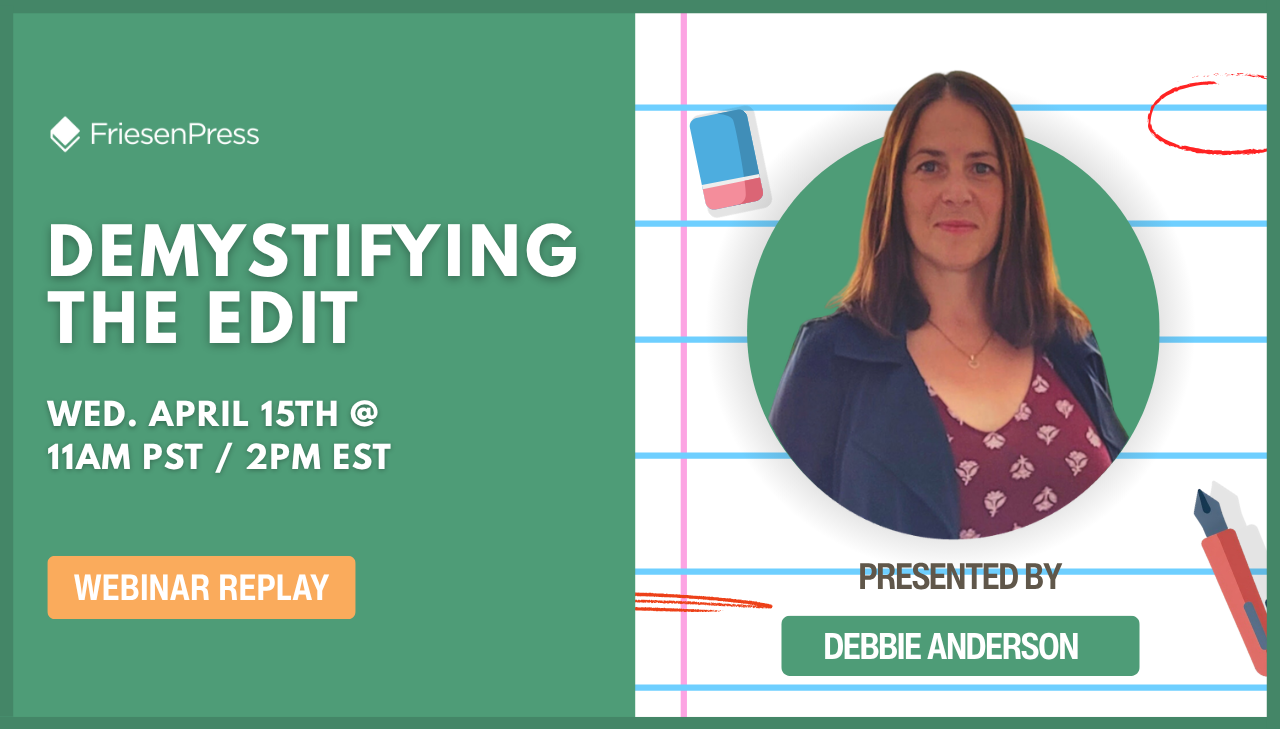
Hi everyone! I’m Debbie Anderson, an Employee Owner and Publishing Consultant here at FriesenPress. I’ve spent nearly 14 years helping authors navigate the publishing journey, and that journey almost always starts with editing.
I talk to authors all day long, every day, and I know that for many authors, the idea of editing brings up a lot of anxiety. We call it "The Myth of the Red Pen"— the fear that a professional is going to take a red pen to your hard work and shred your unique voice. But I’m here to tell you that editing isn't about criticism, it’s about helping your work reach its full potential.
The Editing Process
At FriesenPress, editing is a partnership. We aren't here to tear your work down; we're here to make sure your message is coming across clearly.
Every editor we work with is a qualified professional who has passed stringent examinations based on Editors Canada standards. We also have an internal quality coordinator who checks the work to ensure you’re getting a fantastic, professional service. Unlike traditional publishing, where a publisher might adjust your vision to meet their commercial goals, our process is designed to support your goals while giving you full creative control.
FriesenPress Process
We always start our process with a Manuscript Evaluation. Before we worry about grammar or spelling, a professional editor reads your manuscript in its entirety. They then write a five-to-six-page essay detailing your strengths, weaknesses, and what they recommend for your next steps.
It’s very difficult to dive into editing until you truly understand what the manuscript needs. This stage allows us to find the perfect match for your specific genre.
Why Multiple Edits Matter

Professional editing reduces distractions that diminish your book's readability, such as convoluted content structure, incorrect grammar, and persistent typos. From developmental editing to proofreading, our vetted editing team will match you with the editorial services you need to create the best book possible.
FriesenPress operates at the industry standard professional editing accuracy rate of 90–95%, which implies a margin of error of 5–10% per round. This standard accounts for human error, meaning a small percentage of errors may remain after a single editing pass, necessitating multiple rounds for higher precision.
To cover all aspects of the manuscript and mitigate as many errors as possible, we stick to a multi-stage editing approach. We find that the average manuscript is generally best helped by a content edit, followed by a proofread, but we always adapt to suit the specific editing needs of each author in order to reach their goals.
In traditional publishing, manuscripts typically undergo several rounds of editing, including developmental editing, line editing, copyediting, and proofreading, often involving multiple specialists. This means a single book may be reviewed three to five times before publication, taking many months or even years.
FriesenPress offers an accessible and efficient approach compared to the full traditional publishing process: a practical middle ground that ensures your manuscript receives professional attention without always requiring the time of multiple full editorial cycles, while also maintaining complete control of all final editing decisions.
Traditional Publishing Process
In traditional publishing, editing is also a collaborative process, but it’s ultimately shaped by the publisher’s commercial goals. Editors aren’t working solely on behalf of the author; they’re also responsible for positioning the book in a way that aligns with market expectations and maximizes its chances of success. That can influence decisions around structure, pacing, tone, and content, ensuring the book fits within genre norms and appeals to a broad audience. While this can strengthen a book’s marketability, it can also mean that the author’s original vision is adjusted to meet those objectives.
Because of this, creative control in traditional publishing tends to be more limited. Because of the publisher’s financial stake in the project, they typically wield massive influence – if not final say – on the content. For this reason, while authors are certainly involved throughout the process, editing can ultimately feel more directive than collaborative, focused on shaping the book into what it needs to be for the market.
In contrast, self-publishing editing is usually more of a dialogue, where the author retains full control and the editor’s role is to support and refine the author’s vision rather than necessarily guiding it toward a specific commercial outcome.
Learn to Master Self-Editing
But before handing your manuscript over to a professional editor and diving deep into the editing process, take the time to refine it yourself. Aim to make it as clean, clear, and polished as possible through self-editing.
What is Self-Editing?
It’s not about making your manuscript perfect, no author can reliably catch every issue on their own, but instead about clarifying your intentions, tightening your writing, and smoothing out places where your meaning didn’t fully come through.
Being both the creator and the first critic of your own work is inherently challenging. You know the story too well, and your familiarity makes it easy to see what you meant to write, rather than what’s actually on the page. That’s why self‑editing isn’t just a single pass, it’s a process of stepping back, assessing, and revising with intention.

Why Self-Editing Matters
Doing a thorough self‑edit pays off in multiple ways: it improves clarity, reduces structural errors, and makes professional editing more productive. By clarifying your text and intentions first, a future editor can focus on deeper developmental improvements rather than basic fixes, saving time and money down the line.
It also gives you a stronger grasp of your own work before you talk about it publicly, whether in marketing conversations or when discussing your book with your editor or readers.
Effective self‑editing starts with distance. After finishing your draft, let it sit, ideally for a couple of weeks, so you can return with a fresher perspective. This pause helps your brain catch things it glossed over when you were immersed in writing.
When you begin reviewing:
Prioritize the Big Picture: Start with structural revisions. Ensure the flow is logical and the scenes are in the right order before you worry about grammar. This prevents you from polishing text that might eventually be cut.
Work in Stages: Don’t try to fix everything at once. Do one pass for structure, one for style, and a final pass for mechanics.
Use Fresh Perspectives: Read your work aloud to catch awkward pacing, use digital tools for technical errors, and consider beta readers to help spot blind spots you’re too close to see.
Once you’ve implemented the pieces you knew you wanted to address, your manuscript will be in a cleaner state and you’ll likely feel more confident about its merits. This can be a great time to get feedback.
The Different Types of Editing
Editing that addresses the structure of a book, the development of its content, or the big picture of how its text works together are referred to as structural or substantive edits. Here is how the different stages break down:
Developmental Editing: A holistic, high-level review of your manuscript’s architecture. The editor focuses on structure, direction, and content organization rather than grammar, ensuring your core ideas are solid before you fine-tune the details.
Content Editing: A deeper dive into both structure and prose. This edit improves meaning, eliminates wordiness, and refines expression. It’s ideal for books needing a mix of light structural work and stylistic polishing.
Copy Editing: Performed once the structure is set, this is a line-by-line technical pass. The editor corrects grammar, spelling, punctuation, and syntax to ensure your text is clear, consistent, and professional.
Proofreading: The final "fresh eyes" sweep. This stage catches lingering typos, formatting glitches, and minor layout issues. It doesn't change the story or structure; it simply ensures the book is polished and ready for production.
Managing the Experience
Receiving feedback is deeply personal, and it’s natural to feel a mix of pride, anxiety, or even defensiveness. Your book is a reflection of your hard work, so the first step is acknowledging these emotions without letting them dictate your response.
Instead of viewing critiques as a failure, see them as evidence of your book’s potential. Remember: editing is collaborative, not adversarial. Your editor offers guidance, not commands. Maintaining a balance between your creative instincts and professional judgment is key to staying confident throughout the journey.
Practical Benefits of Professional Editing

Self-publishing offers unique advantages that traditional models often don't, especially during the editorial phase:
Total Creative Control: You make every final decision. You can implement professional suggestions that enhance the manuscript while ensuring your original vision remains intact.
Professional Quality & Readability: An edit removes distractions like grammatical errors and structural gaps. This increases reader engagement and ensures you're putting a high-quality product onto the market.
A Personalized Process: You choose the editor and the timeline. The journey is tailored to your comfort level and creative goals rather than a publisher’s commercial priorities.
Built-in Confidence: Moving toward publication is much easier when you know your work has been vetted. This process gives you the authority and peace of mind needed to promote your book with pride.
Preparing for the Editing Process
Once you’ve written your manuscript, it’s time to focus on the next task at hand: preparing your manuscript to submit to your publishing partner. Fortunately, this part of the journey is much less arduous than the writing process.
To prevent unnecessary costs, it’s best to ensure your manuscript is as clean and clear as possible:
Start with a Fresh Document: Copy and paste your final draft into a brand-new, blank file. This strips away hidden formatting glitches and "legacy" quirks that accumulate over multiple rewrites, which can interfere with the editing and design software later.
Keep Formatting Standard: Avoid decorative fonts. Stick to basics like Times New Roman, Arial, or Calibri (11–12 pt). Simple formatting ensures your editor spends their time on your content, not adjusting your presentation.
Prioritize Readability: Use left-aligned text with a ragged-right margin and single-spacing between sentences. For paragraph breaks, choose one style—either a 0.5" indentation or a clear space between paragraphs—and stay consistent. Never use the spacebar or tab key to manually create a layout.
Clear Dialogue: Each speaker’s lines should begin on a new paragraph with consistent quotation marks. This allows the editor to follow the flow of conversation easily and provide more meaningful feedback on your story’s natural rhythm.
Organization: Ensure your chapters are in the correct order and include all front matter (title page, acknowledgments, table of contents). Remove any temporary notes or placeholders. Crucially, add consistent page numbering in the headers or footers so your editor can easily reference specific sections in their feedback.
Use Proper Page Breaks: Never hit “Enter” repeatedly to start a new page. Instead, use the “Insert Page Break” function. This ensures your chapters stay in place even as text is added or removed during the edit, preventing a formatting nightmare during layout.
Set Language and Run Basic Checks: Before submitting, verify that your document’s language settings match your preference (e.g., Canadian, British, or US English). Run a final spell and grammar check; cleaning up these basic errors allows your editor to focus on high-level improvements rather than simple typos.
Polished References: For nonfiction, ensure your citations and bibliography are complete and follow a single style guide (like the Chicago Manual of Style). In fiction, double-check that factual details are accurate. Clean references build your authority as an author and save the editor from having to verify basic sources.
Q/A Section
Q: How many rounds of editing can I actually expect my book to go through?
Debbie: The key is to have multiple rounds if it's at all possible. We always want to work with what is best for your manuscript, but we also realize we’re working with what your budget allows for. It’s about finding that middle ground that works for you.
In traditional publishing, a book might go through seven or eight rounds of editing—it’s a lot! With us, you can do as much as you want, but we always recommend at least three stages. We start with that initial evaluation, and then ideally move into a copy edit followed by a proofread. Of course, that path can shift; you might decide you need a round of developmental editing first to get the foundation right before you move into the technical stuff. The goal is to be flexible to help you reach your specific goals.
Q: You mentioned an industry-standard accuracy rate of 90–95%. Can you explain how that works in practice?
Debbie: It really comes down to the fact that our editors are human. They are highly qualified humans, but there’s always that small chance a spelling error might be missed in a single pass—that’s actually considered normal within the industry.
Now, if a manuscript had a ton of errors left, that’s not something we accept here at FriesenPress. We have very high standards. But this is exactly why we advocate for multiple rounds. By the time you’ve gone through the full process and you’re moving into the design stages, there should be very, very few errors left. That’s the level of polish we want to see for every author.
Q: I write in a very niche genre. Do you have editors who can support my journey without erasing my original voice or vision?
Debbie: Absolutely. We’re currently working with over 50 editors, and we have a dedicated editing coordinator whose whole job is to ensure we have experts across every genre. It’s very rare that we get a request for a niche subject that we can’t support.
This is another reason why starting with the initial evaluation is so key. It’s not just about the feedback; it’s a "test drive" to see if we got the fit right. Do you feel like the editor understood your manuscript and the path you want to take? If, in a rare instance, you don't feel that connection, we look at other options. We want someone who sees your vision and helps you get there.
Q: How is the editing process different for a children’s book versus a long novel?
Debbie: I love this question because people often think a 500-word children’s book shouldn't take as much work as a 60,000-word novel. But it’s a completely different skill set.
Our children’s book editors look at things like your specific target audience. If you’re writing for three-to-five-year-olds, is the language appropriate? If there’s rhyming, is the rhythm and cadence working? They also look at length—no four-year-old is going to sit through a 50-page picture book! You need an editor who understands the children's market to make sure all those parts are working together.
Q: How long does an edit take for a standard manuscript of about 200 pages?
Debbie: Generally, for that initial evaluation, you’ll have your feedback back in about two weeks. After that, you’re usually looking at about three to four weeks for each subsequent round of editing.
Of course, it depends on the length and the type of edit—a 600-page developmental edit is going to take longer than a 200-page proofread. We do our best to stick to specific timelines so you can stay on a schedule and anticipate exactly when you’ll be through the process.
Q: What are your feelings on using AI for the editing or review process?
Debbie: This is a hot topic right now! At FriesenPress, our vision is that humans do the job best. There’s just nothing that can replace that human touch.
We know authors use tools like Grammarly for self-editing—and that’s essentially AI—but we have a strictly human process for our professional services. We don't use AI in our editing. Also, I always tell people to proceed with caution with generative AI. It can close doors on things like copyright and book awards, and that landscape is changing every few months. For us, keeping the human side focused is the priority.
Q: I’m worried about someone stealing my work if I share it. How do I learn to trust an editor?
Debbie: I hear this anxiety a lot, and you’re right to be cautious. You shouldn't be emailing your manuscript everywhere. You need to do your research: check Google reviews, look at the Better Business Bureau, and make sure the company is legit.
One thing we do to help with that trust is security. We won't ask you to email us your manuscript; you’ll always upload it through a secure, password-protected site that goes directly to our editing team. It’s about making sure you feel comfortable with the people you’re trusting with your work.
Q: How do I know when I’m actually ready to stop self-editing and hire a professional?
Debbie: You don't want to wait too long. I’ve talked to authors who sat on a book for years until they were so sick of it they didn't even want to hear feedback anymore. You don't want to reach that point!
You should definitely do some self-editing—don't send it to an editor the day after you finish the draft. But you don't need it to be perfect. You’re ready when you need that outside perspective to show you the next step. Whether you follow every suggestion or go back and revise for another few months, that professional feedback is what drives you forward on your journey. That’s the most important part.

Want more expert insights to help navigate your publishing journey?
Join our next free webinar! Presented by FriesenPress’s Diane Cameron, The Power of the Book Proposal, where we walk you through the process of creating a transformative book proposal of your own.


